

L'Evoine Knowledge Series · Horse Health
Fascia in horses – anatomy, function and importance for health
Fasciae have long been overshadowed by muscles, bones, and tendons in equine anatomy. However, current research shows that they are among the most crucial functional tissues in the horse's body. This article from the L'Evoine Knowledge Series explains the structure of fasciae, their functions, and why their care is so important for a healthy, high-performing horse.
1. Was sind Faszien beim Pferd?
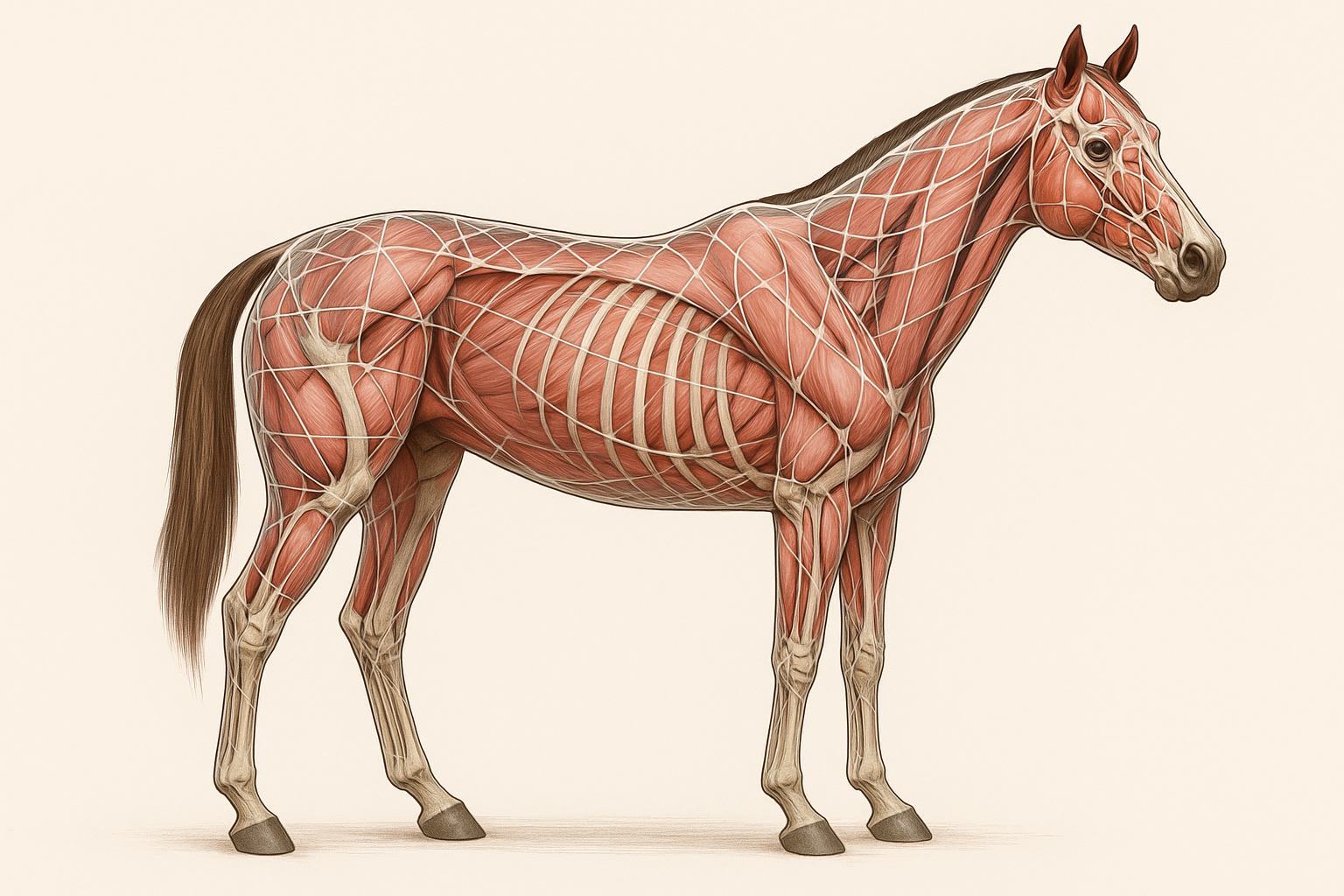
Fascia is a three-dimensional, collagen-rich connective tissue that permeates the entire horse's body like a continuous network. Unlike muscles or bones, fascia is not merely passive structure: it connects, envelops, and stabilizes all tissues, thereby enabling coordinated movement of the entire body.
In horses, fascia are particularly pronounced and anatomically complex, due in part to the large body volume, long limbs, and the high biomechanical forces exerted during galloping, jumping, or collection. The fascial network comprises:
Superficial Fascia : Between skin and muscles, rich in nerves and fluid.
Deep Fascia : Envelops individual muscles and muscle groups and forms the "guidelines" of movement.
Visceral fascia : Stabilize and connect internal organs.
Modern research shows that fascia in horses are far more than just "coverings": they are actively involved in movement, force transmission, body awareness and coordination.
2. Aufbau des Faszialen Systems
The fascial system is made up of several layers that glide together, transmit information and coordinate movements.
1. Superficial Fascia
This layer lies directly beneath the skin and is characterized by high elasticity. It contains numerous free nerve endings and is therefore sensitive to pressure, touch, and friction. This is one reason why horses react so sensitively to grooming or equipment.
2. Deep muscular fascia (Deep Fascia)
It tightly envelops the muscles and connects entire muscle groups into functional chains. This layer is particularly important for:
- power transmission
- stability
- movement coordination
3. Myofascial pathways
These are comparable to the human "anatomy trains" and run through the back, neck, torso, and limbs. Adhesions in one of these pathways can affect movement patterns throughout the entire body.
4. Visceral Fascia
They hold organs in place and connect the chest and abdominal cavities. Tension in these fasciae can manifest in trunk movement or breathing.
The interplay of these layers determines how smoothly and efficiently a horse can move.
3. Aufgaben der Faszien
Fasciae perform several key functions:
1. Power transmission
They transmit forces originating in the hindquarters via the back to the forehand. This creates a harmonious movement pattern – or, in the case of disturbances, an uneven flow of movement.
2. Shaping and stability
Fasciae give structure to the horse's body. They hold muscles, tendons, and bones in defined pathways and stabilize joints without restricting movement.
3. Lubrication of tissues
The more supple the fascia, the better muscle layers can glide past each other. Loss of this gliding ability leads to stiffness, tension, and reduced performance.
4. Proprioception (body awareness)
Fasciae contain a large number of receptors that provide feedback about position, tension, and movement. A large part of a horse's balance and coordination abilities arises from this system.
5. Fluid and Metabolism
Fasciae transport interstitial fluid, support detoxification, and influence cell metabolism. Well-hydrated fasciae = better performance
4. Verklebte Faszien
Adhesions occur when fascia loses its ability to glide. Causes can include:
- too little free movement
- monotonous training
- overloading of individual structures
- stress and protective postures
- unsuitable equipment
- injuries or inflammation
Typical signs of fascial adhesions:
- a “rigid” or flat back swing
- reduced shoulder freedom
- shorter steps, especially in front
- rhythm irregularities without orthopedic findings
- sensitivity when grooming or saddling
- severe muscle tension or “knots”
- difficulties in bending, positioning, or assembly
Adhesions in the fascia can extend along entire myofascial pathways and thus even affect distant regions of the body.
5. Einfluss von Haltung & Equipment
Posture, movement, and equipment have a huge influence on fascia quality.
1. Posture and movement
Horses need plenty of free movement every day, ideally varied and with diverse natural terrain. This is the only way to keep their fascial tissue elastic, hydrated, and resilient.
2. Training
Variety is crucial:
- side passages
- lunging in good forward-downward stretching
- cavaletti
- terrain
Overly monotonous work (e.g., only dressage, only circles, only trail riding) puts uneven strain on the fascia.
3. Influence of the equipment
Fasciae are sensitive to pressure, friction, and localized stress. Ergonomic, pressure-distributing saddle pads can help reduce pressure points and support the natural movement dynamics of the fascial structures.
Conversely, an unsuitable saddle or inferior material can restrict movement and promote adhesions.